 |
| Saturn's Beautiful Rings |
This Blog is about new discoveries taking place in the Universe. Everything from supernovae to Pulsars with definitions on different kinds of stars and great telescopes. The final frontier!!!
Sunday, July 25, 2010
Saturn

Jupiter
 |
| The Great Red Spot |
Comets
 |
| The Comet Hyakutake |
Asteroids

Mars

Black Holes
 |
| Black Hole Drawing |
Black holes are small areas of space that have such strong gravity that nothing, not even light can escape. planets, stars, gas dust, and even energy are devoured by black holes. Some people think that black holes can teleport you to other places. The bitter truth is that they are angry beasts that rip everything apart atom by atom. Black holes are one of the most powerful forces in the universe. They are collapsed supergiant stars. They are only detected when the start swallowing a star because, suddenly, the star is gone.
Venus
 |
| The surface of Venus |
Mercury

Stars
Stars usually seem very simple, but thats far from the truth. Stars are fueled by nuclear fusion. Stars are massive enough that hydrogen is changed (by nuclear fusion) into helium. This change creats heat and light energy. Some stars are larger that others because there is more Hydrogen inside of them. Supermassive stars have very short lives of only a few million years because they burn their fuel faster. People only recently discovered what fueled a star.
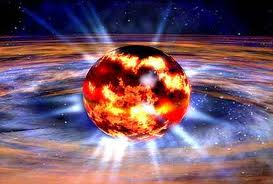
Stars of all shapes and sizes are in a constant battle against their own gravity which is trying to pull the star into itself. The only thing stopping this from happening is the star heat and light output is pushing against the gravity. So, naturally, when a supergiant star runs out of fuel it collapses into itself. The result is a massive explosion known as a supenovae. In the center of the debris is the colapsed core of the star it is a neutron star (for more info on neutron stars, I have an entry on them as well). If the star was massive enough it would be a black hole. I will have information on black holes very soon.
 |
| Neutron Star in center of a SuperNovae |


Hubble
The Hubble space telescope is now celebrating 10 years of discoveries! Outfitted with the latest equipment, Hubble is ready for 10 more!! Talk about Hubble Via Twitter, Myspace, Facebook, and Skype to share your feelings!
 |
| Hubble Space Telescope |
Nebulas
 |
| Crab Nebula |
A nebula is a cloud of gas and dust that is the result of a supergiant star explosion. A nebula is sometimes called a interstellar nursery. New stars are born in nebulas and there is usually a neutron star in the center, like the neutron star in the center of the Crab Nebula, one of the most famous nebulas in the universe. The Crab Nebula is the result of a supernovae explosion that took place during the 1000's. It was as bright as our moon in the night sky for several weeks and the brightest in history. This supernovae was best documented by the ancient Chinese. Nowadays you need a good telescope to See it.
Neutron Star

All neutron stars are surrounded by a nebula.
Pulsars and Quasars
 |
| Pulsar Drawing |
Pulsars and quasars are some of the most interesting object in the cosmos.
Pulsars: Pulsars are fast rotating neutron stars. It is still unknown what causes them to spin so quickly. A pulsar has 2 streams of radioactive particles streaming out of it's poles. The name is just short for pulsating star. They appear to blink in the night sky. There is a pulsar in the center of the famous crab nebula. An average pulsar is just the size of Manhatan. and orbits once every 1 or 2 seconds.
 |
| Quasar Animation |
Quasars: They are strange even for black holes. A quasar is a supermassiveblack hole in the center of a galaxy (Not all galaxies have one, the milky way and many others do not. Quasars are not very common.) The light from a quasar is emited from it's poles, as you can see from the drawing. The light comes from the gas of stars that are being devoured. Sometimes the gas can spread through hundreds of lightyears. These are called Dragns. It is not possible for a quasar to be a star.
The Universe

The Universe is my favorite show on History and is very informative about comets, planets, stars, and galaxies. I suggest that you watch the premiere.
Subscribe to:
Comments (Atom)